Rue de l’Economie
2026
Aviation Hall, Royal Military Museum Brussels, Belgium
2026
Aviation Hall, Royal Military Museum Brussels, Belgium
2026
Kölnischer Kunstverein, Cologne, Germany
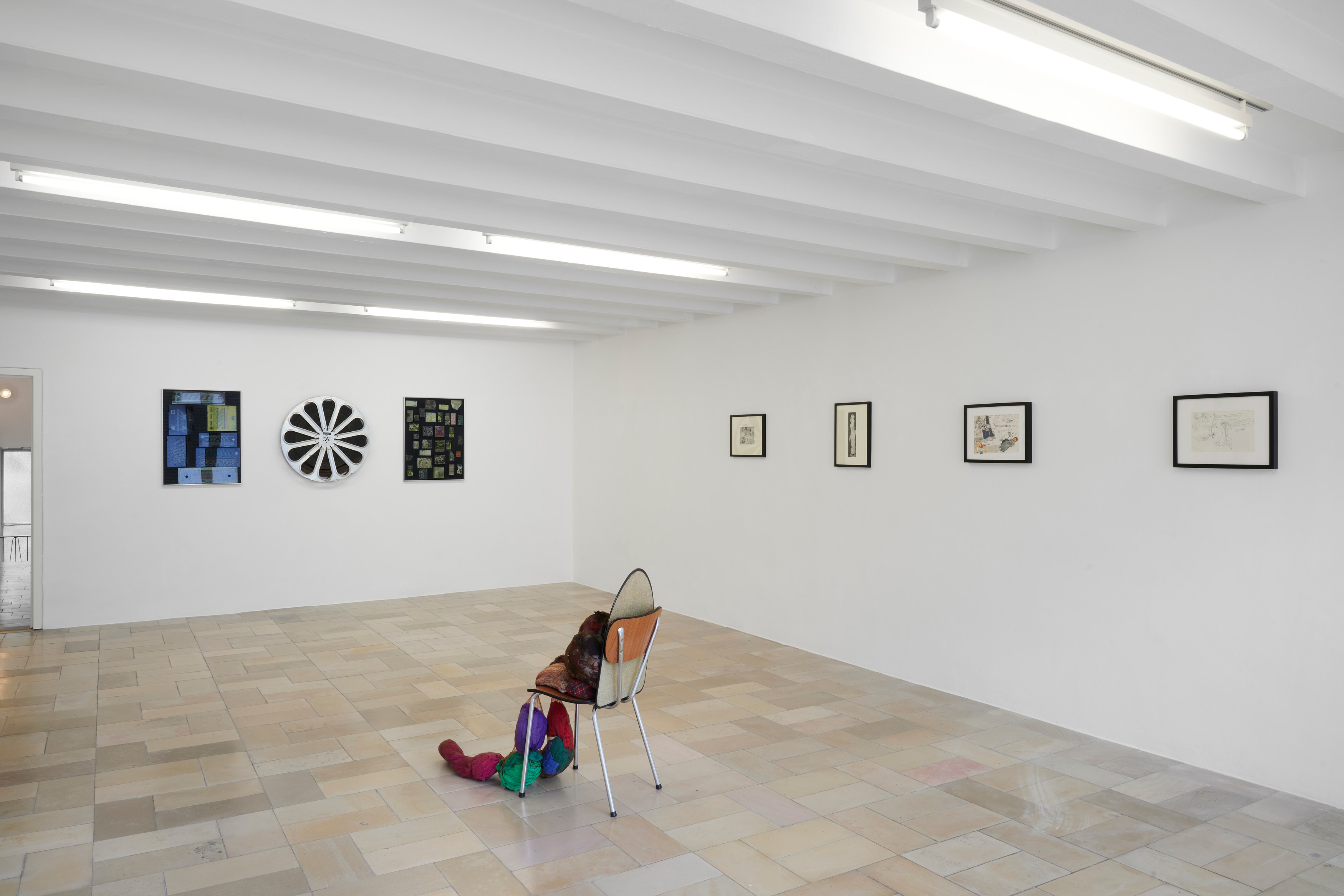
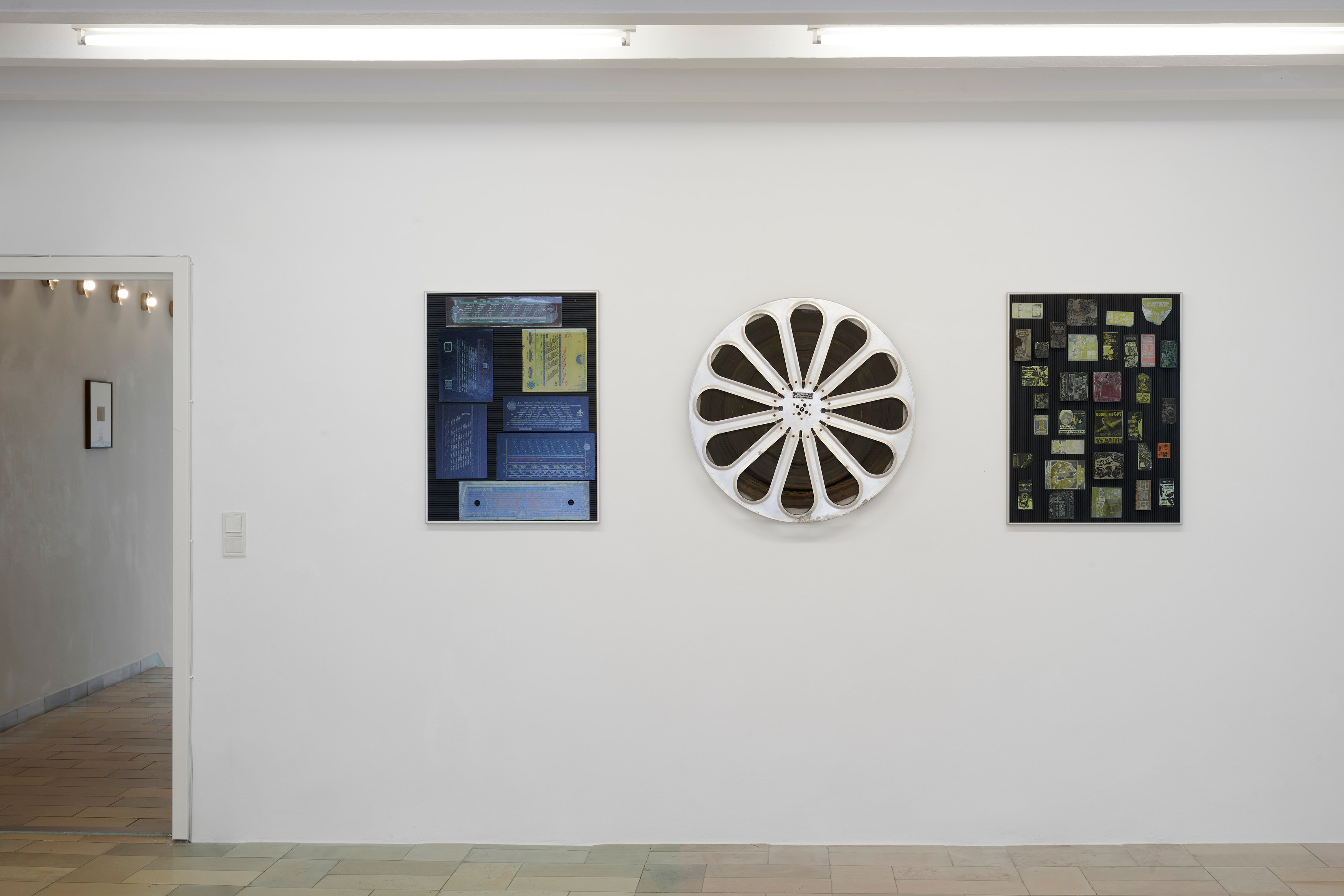
Film reel, film strip, printed panels (plastic/metal), found technical plates, wood frame, mixed media, 80 × 200 cm
2023
Centralbanken, Oslo, Norway
Ots cannibalistic approach to art making is thus reflected on his reworking of found imagery and footage, turning the dead ends of celluloid into strikingly brand new pieces. The video Milk and Lucky Strike (2024)—made of edited reels of propaganda film produced by the Belgium government—depicts humankind and machine as one single entity, as if the former had ever existed only in relation to the latter. In this work, the artist prompts us to peep into an upside-down scenario where heavy metal & milk & IBM computers share the very same institutional narrative (industrial plot), and what used to operate as an assembly line forcibly disintegrates into a milky reverie of post-industrial data—aka information technology (or society).
The second video in the exhibition, Maps (2024), confronts us with a panoply of statistics’ cards displaying flows of imports/exports of natural resources from all over the globe: lead to aluminum and nickel, coffee to uranium, and so forth. In other words, the nourishing of extractivist capitalism turned into virtual feedstock—and over the frantic edition of images, a voice off reminds us that maps are conventions and we should carefully navigate flat surfaces (or engage with totalizing narratives).
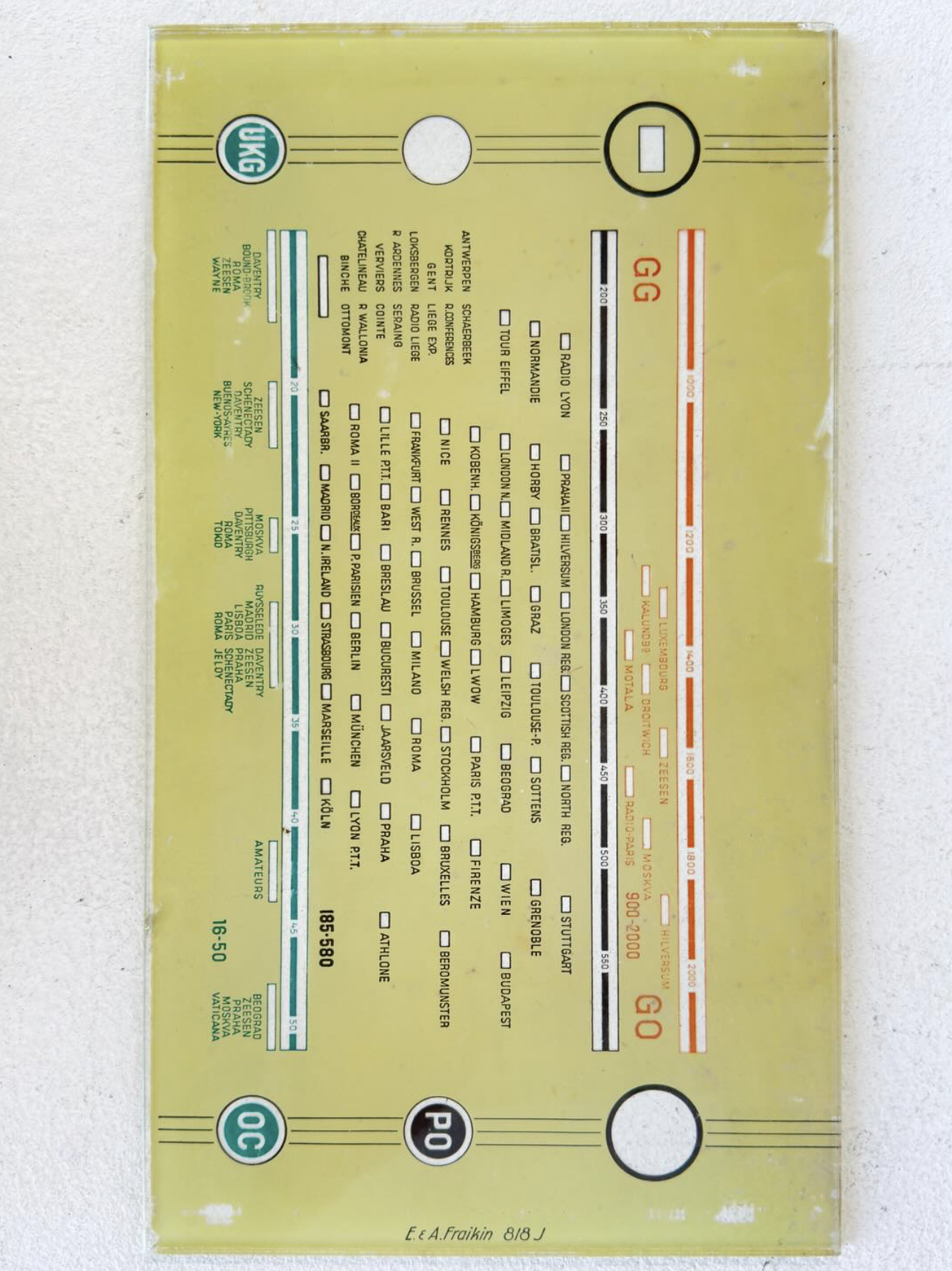
Following this carousel of information emanating from a Eurocentric culture, we encounter Dividor (2024), an assorted variation of transmitter glasses (or dials from old-fashioned radio machines) that signal a wide range of countries and cities around the globe from where myriad of voices, music or information emanate and could possibly be heard. Since they all date back to the 1940’s, the coexistence of far apart places onto one single radio device enquires not only about an implausible conviviality but also an impossible on—the ethereal notion of democracy versus peremptory colonial narratives, past and present.
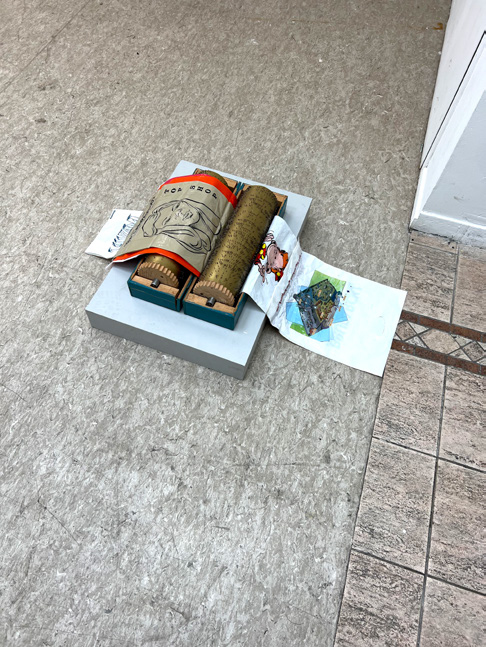
Lastly, one of the key pieces amongst the works assembled in this exhibition is a sculpture/machine, Instrument (2023), where plastic bags of old-fashioned shops are pierced by what seems to be the metal roll of a giant music box; or, perhaps, the mechanism of an early card-operated computer.
Amongst old logos, inner parts of faceless machines and flows of goods, we drift about a dystopian world —a farce of sorts, a story told in shreds, bits and bobs of a reality that was never designed to hold itself together; a world of dysfunction, of impermanence, of leftovers and disposable entities. Only a flea finds its ways over the inscrutable thick skin of central European societies.
— An excerpt of the text by Bernardo Jose de Souza
2023
Gallery Beige, Brussels, Belgium
Photoalbums, glue sticker and wood
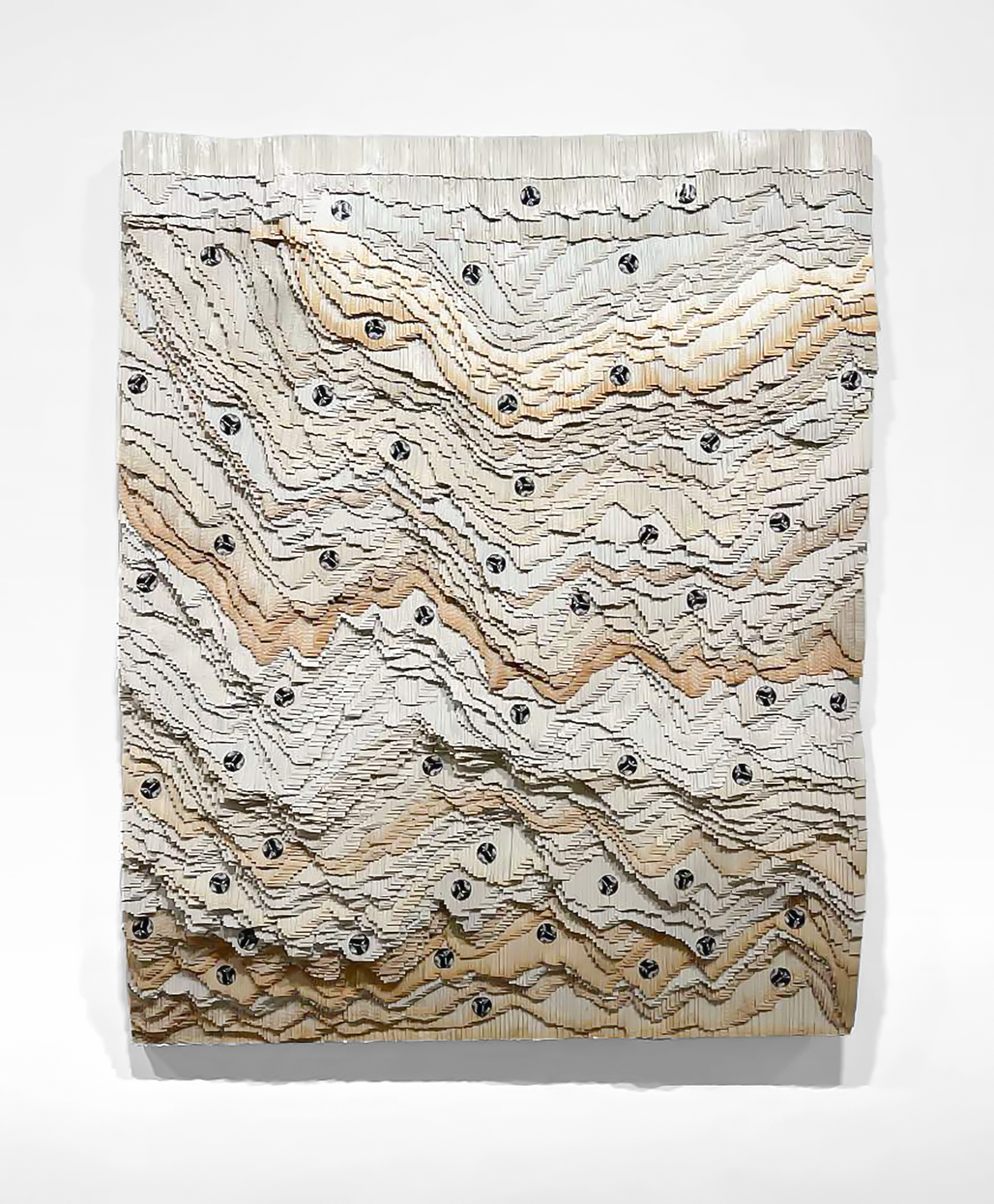
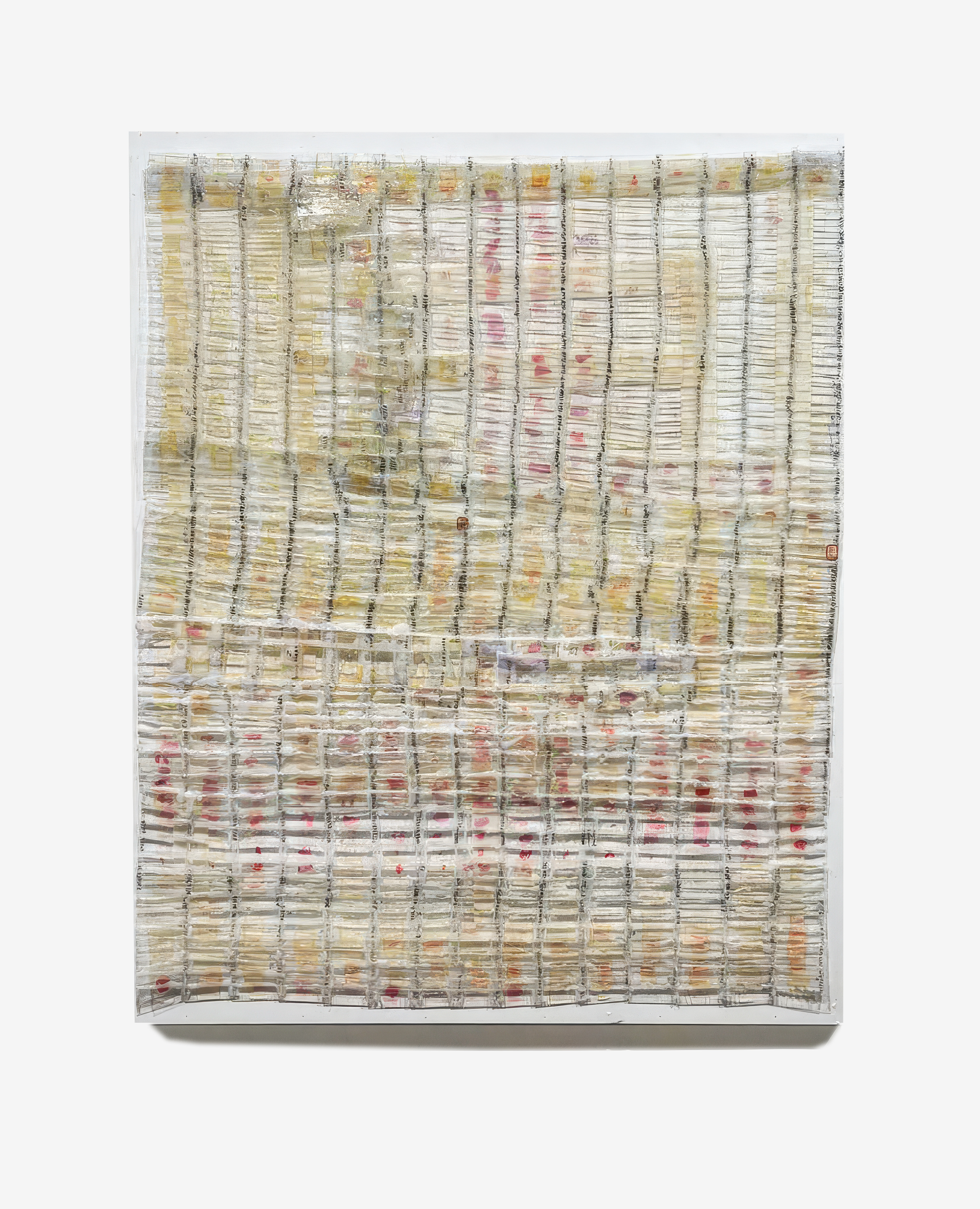
Jurgen Ots builds a layered and densely packed body of work that is a continuation of his research on the life of objects and their circulation. His method is so tightly woven into his life that the two are indissociable. Each day in Brussels, Ots scours the infamous Jeu de Balle flea market with religious devotion, guided by a visual and tactile intuition for the materials sold there. Jeu de Balle is a labyrinth. The objects found in its disarray have acquired many lives, traversed geographies, hands, domestic spaces. Consequently, their financial value is highly abstract and they are indisputably marked by personal histories of unknown humans, which makes every piece a unique container of mixed past emotions. Depending on whether Ots is in love or love sick, optimist or distraught, or what substances flow through his veins, his thirst for these market objects varies like his mood. It is in this mesh of urban life that the artist obsessively stockpiles maps, books, educational material, manuals, obsolete technology, clothes, and accessories. These articles are later transformed with utmost precision in his studio—an intense sculptural twisting and turning, executed with the help of friends and lovers, brings to life these aged materials in radically new forms. They are invariably recast into intricate assemblages where meaning is encoded, as are tapestries or rosaries.
—An excerpt of the text byNatalia Valencia Arango
2022—2023
Glass negatives and whood glue
2021
NICC, Brussels, Belgium
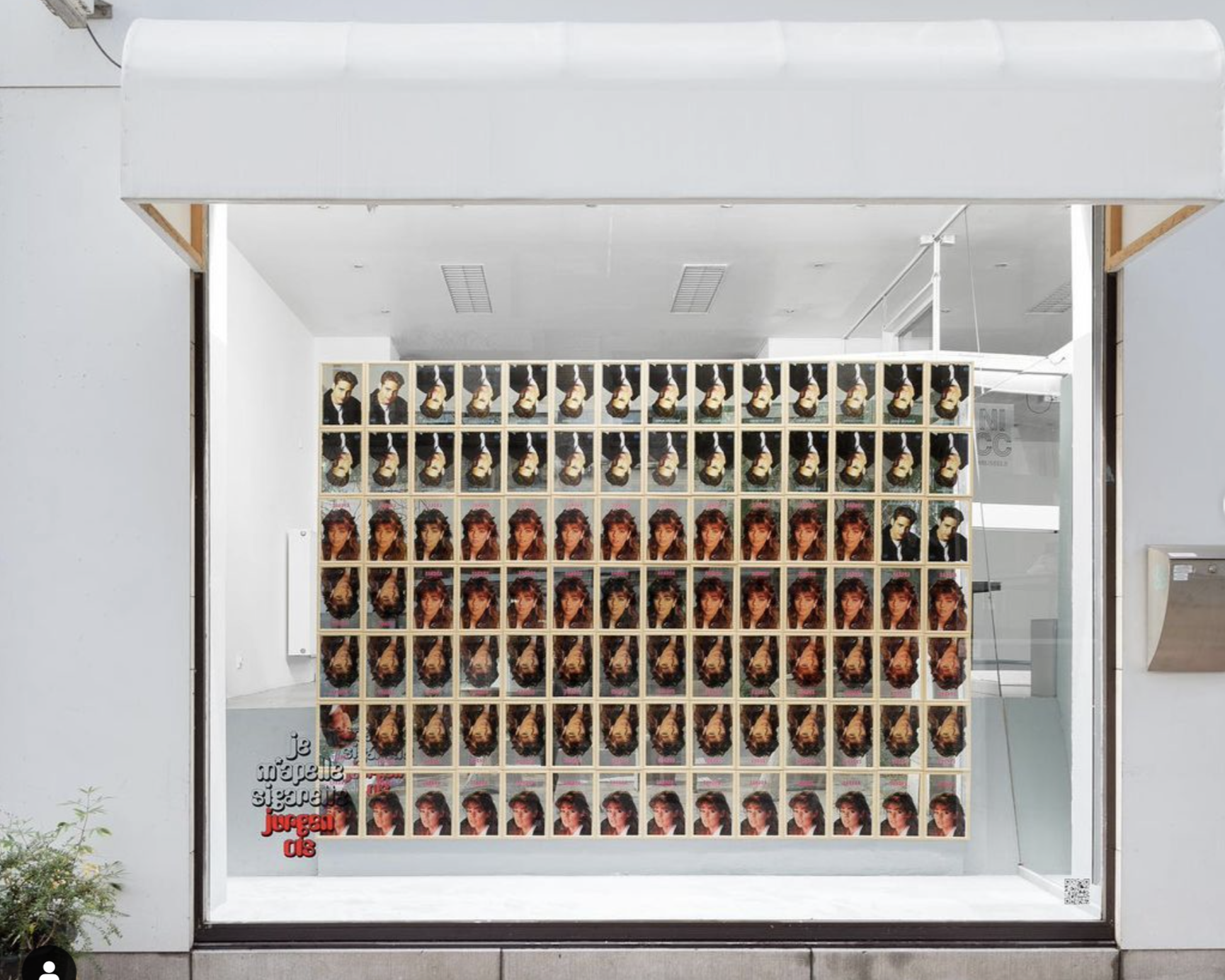

For Je m’apelle sigarette—a pun imagined by the artist as a stereotype of a misunderstanding between the English and French translation—Jurgen Ots covers the entire front wall inside the shop window with a hundred frames. On these plastic frames made of mirrors, two portraits are printed. Brandon Walsh, a fictional character from the American series Beverly Hills: 902010, is confronted here with the German singer Sandra Ann Lauer. This type of object appeared in the 90’s when the veneration of a celebrity—mostly by a young audience—became a commercial tool. The word “fan” took on its full meaning. The goodie industry emerged when companies started to mass-produce merchandising items with the faces of famous and popular characters. In addition to covering all the walls of their rooms with posters, teenagers could drink from a mug with the image of their idol printed on it, wear a T-shirt with the image on it, or carry it everywhere as a key-ring like a religious icon. Here, the mark of the original image where the two icons are revealed dissolves. The repetition of the printing processes and the hanging in an inverted grid alter the subjects and add a tragic feeling to these humans who then become contemplative objects and reflections of a society composed of artifacts.
—An excerpt of the text by Haris Giannouras
2021
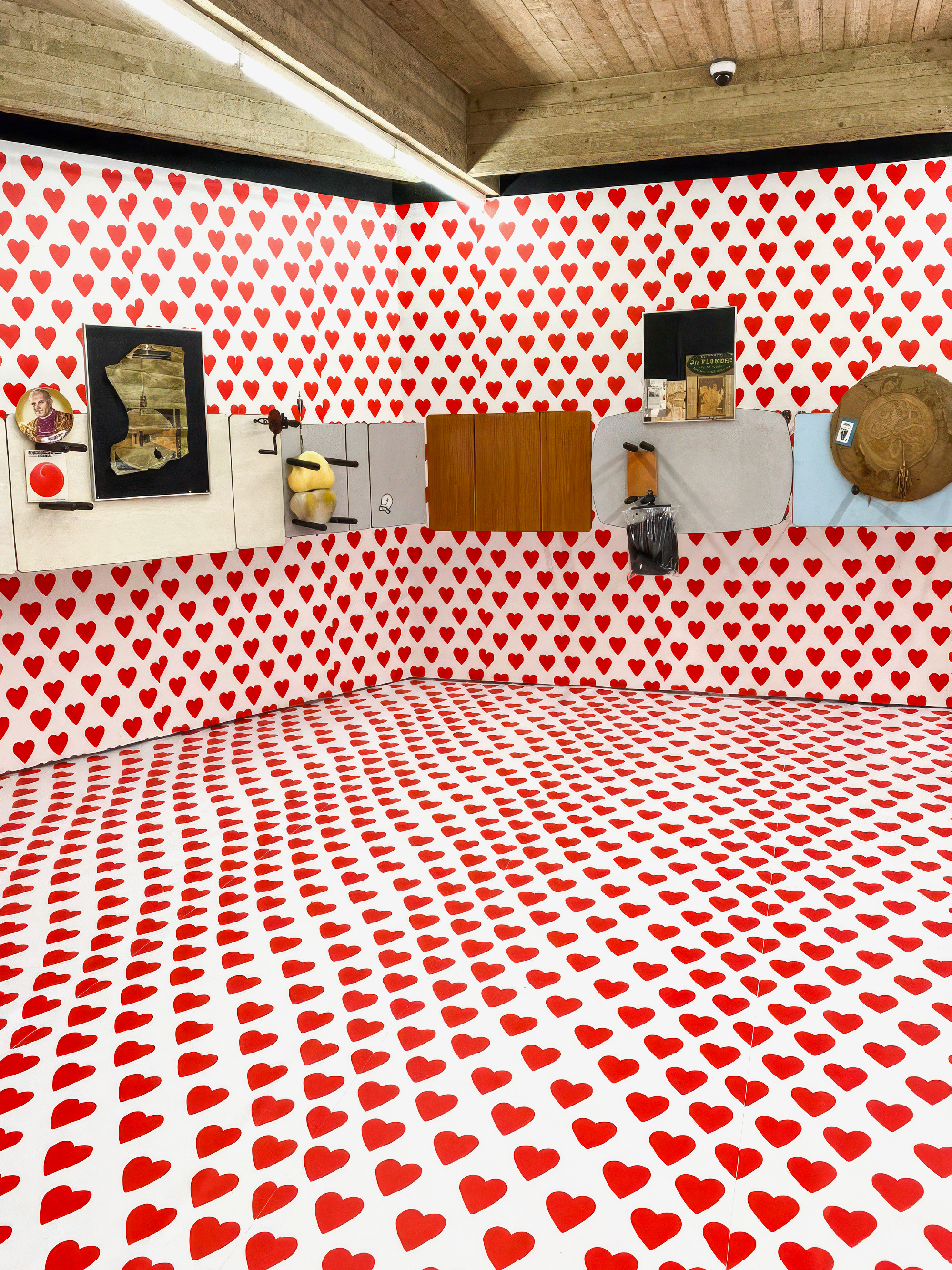
2021
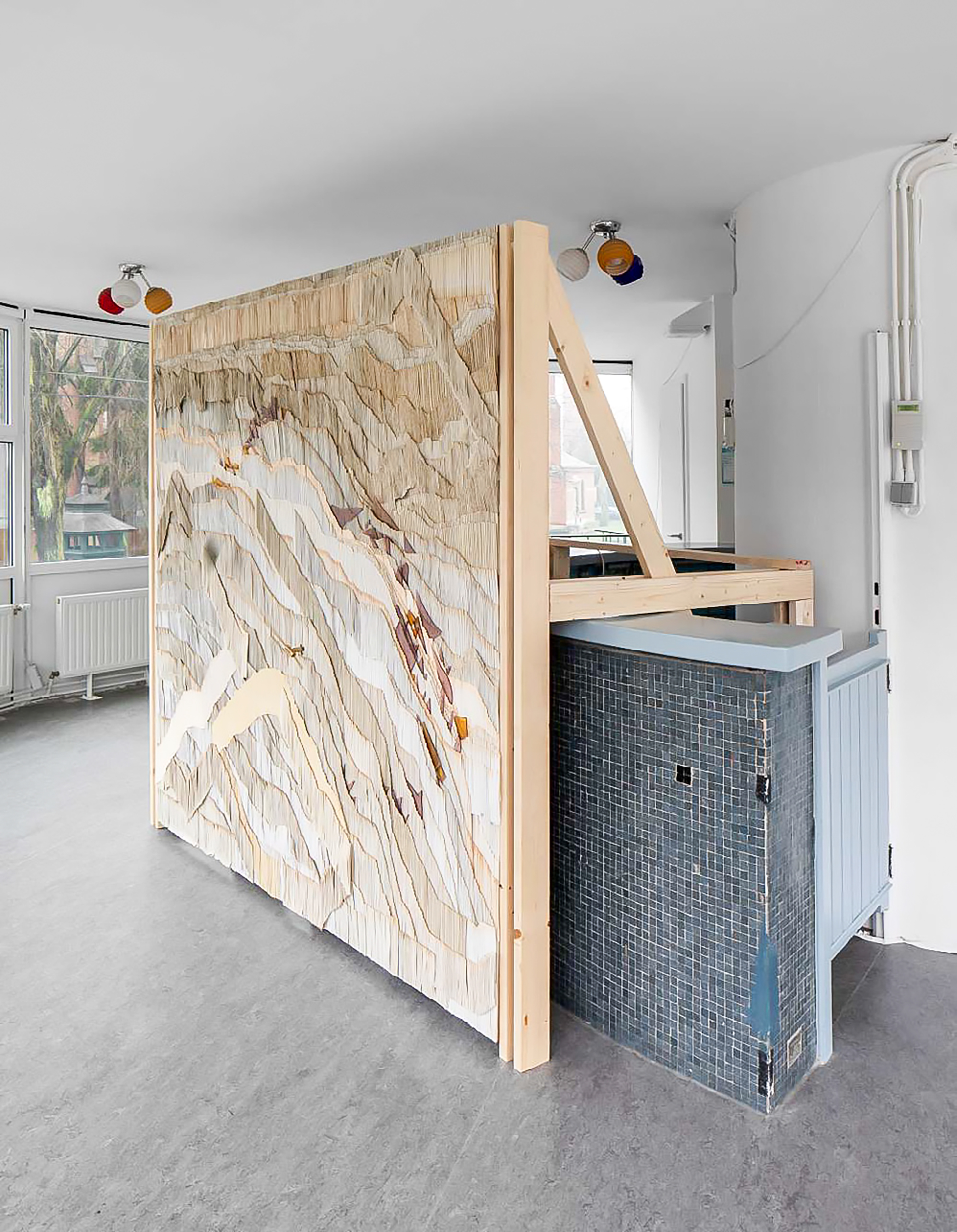
One common way of thinking about the archive is through the scope of its institutionalization: a space, a structure or a building; a form created with the intend of storing information, that may or may not be accessible to a broader public. An important aspect that reveals a great deal of things about this space is its relation to time: what enters the archive comes from the past and is stored in order to be kept alive for the future.
—An excerpt of the text by Haris Giannouras
2021
200 × 200 cm
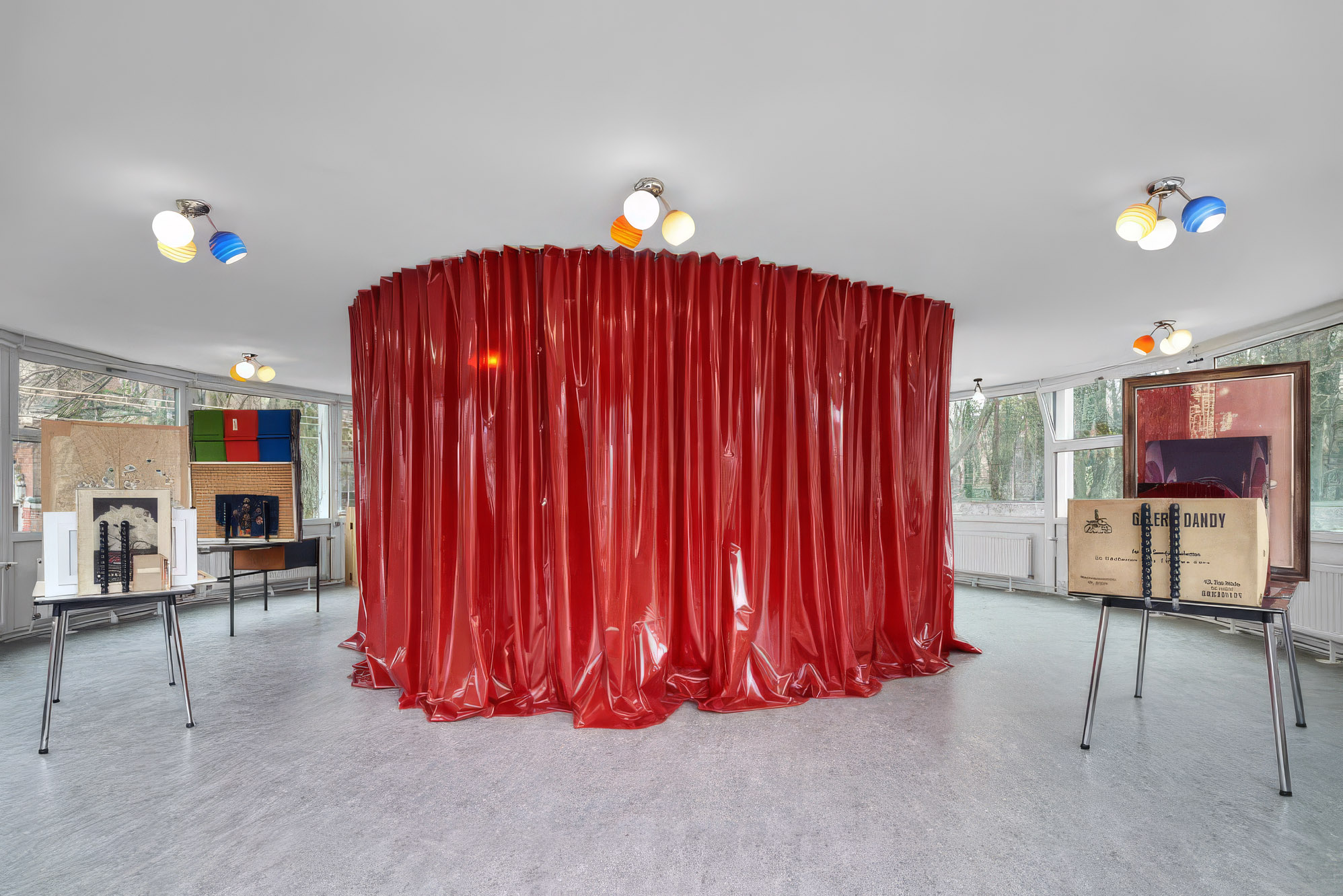
Jeu de Balle is a labyrinth. The objects found in its disarray, have acquired
many lives, transversed geographies, hands, domestic spaces. Consequently, their financial value is highly abstract. Ots scours the flea market with religious devotion, guided by a visual and tactile intuition for the materials sold there everyday.
—An excerpt of the text by Natalia Valencia Arango
2020
From 2020 QuickTime Player, memory stick, collage, no sound, 200 × 200 cm
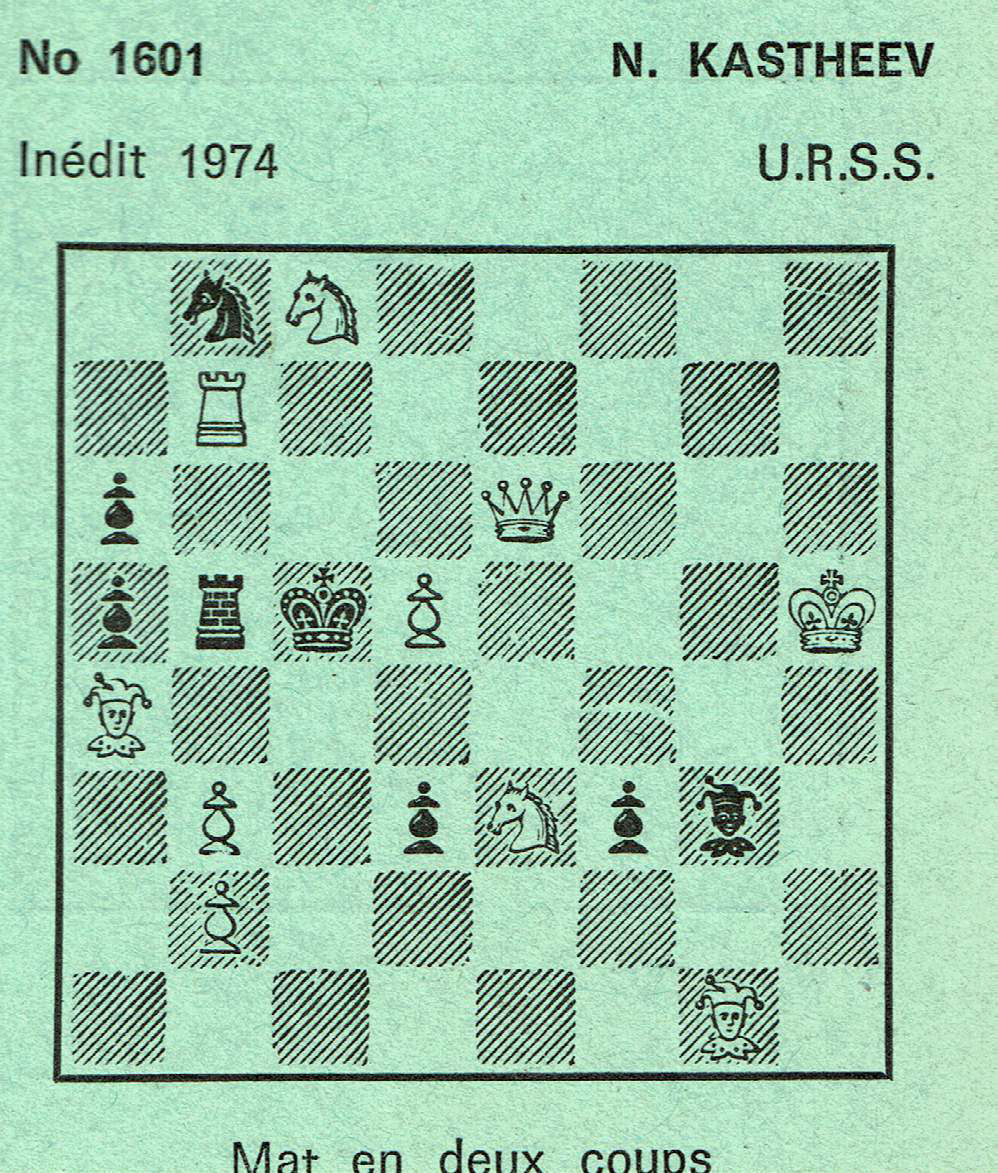
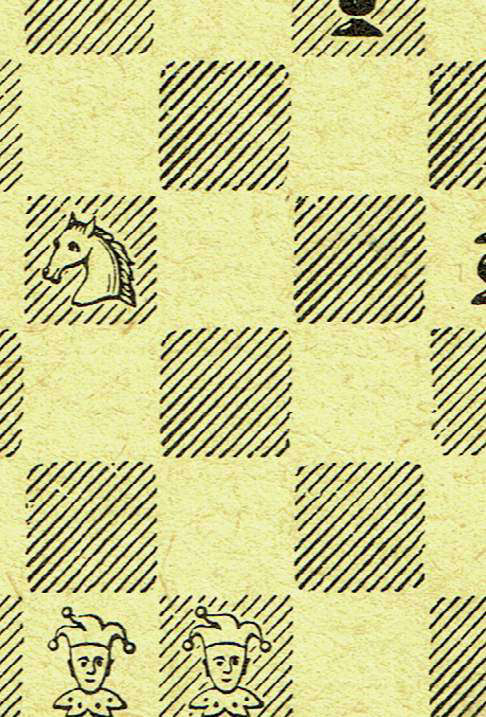
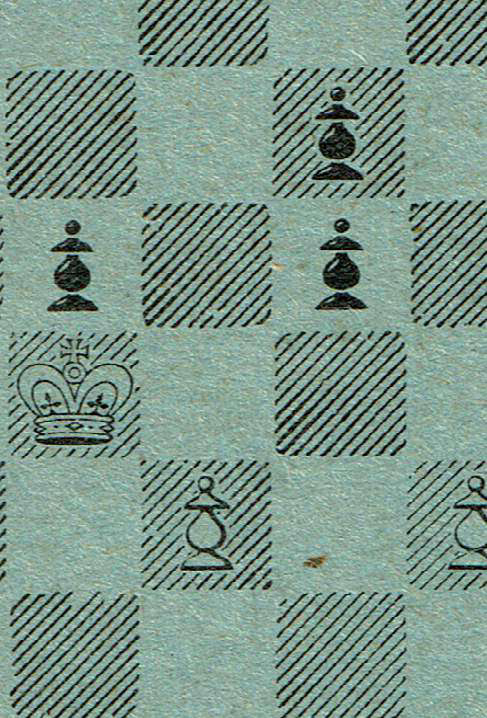
The video is 35 seconds the title is ‘Are we Arc?’ 2020, animated scans 1929/1978. The images are stop motion scans and edit of chess play tips, techniques and tricks from period 1929 till 1978. The images are from different time periods, where political and social changes occurred, furthermore a territorial shifting faded location indication like USSR, GDR, Yogoslavia etc are visible. The colours are faded within the time and form a specific fresque-like colour palette, showing a frozen utopian time frame.
2022
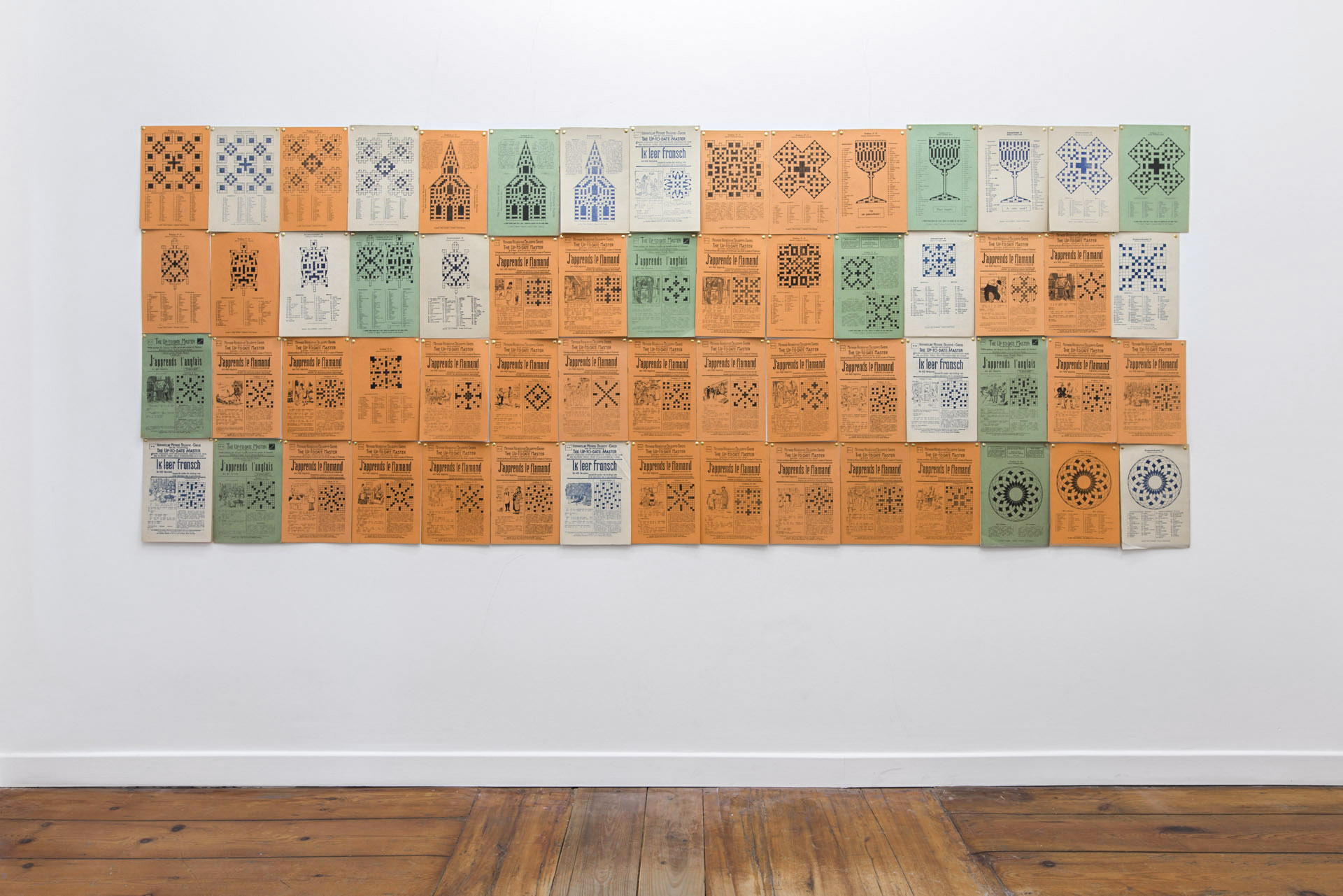
Covers of language courses, found material, variable dimensions
2012–2014
Sculpture, reflective screens, variable dimensions
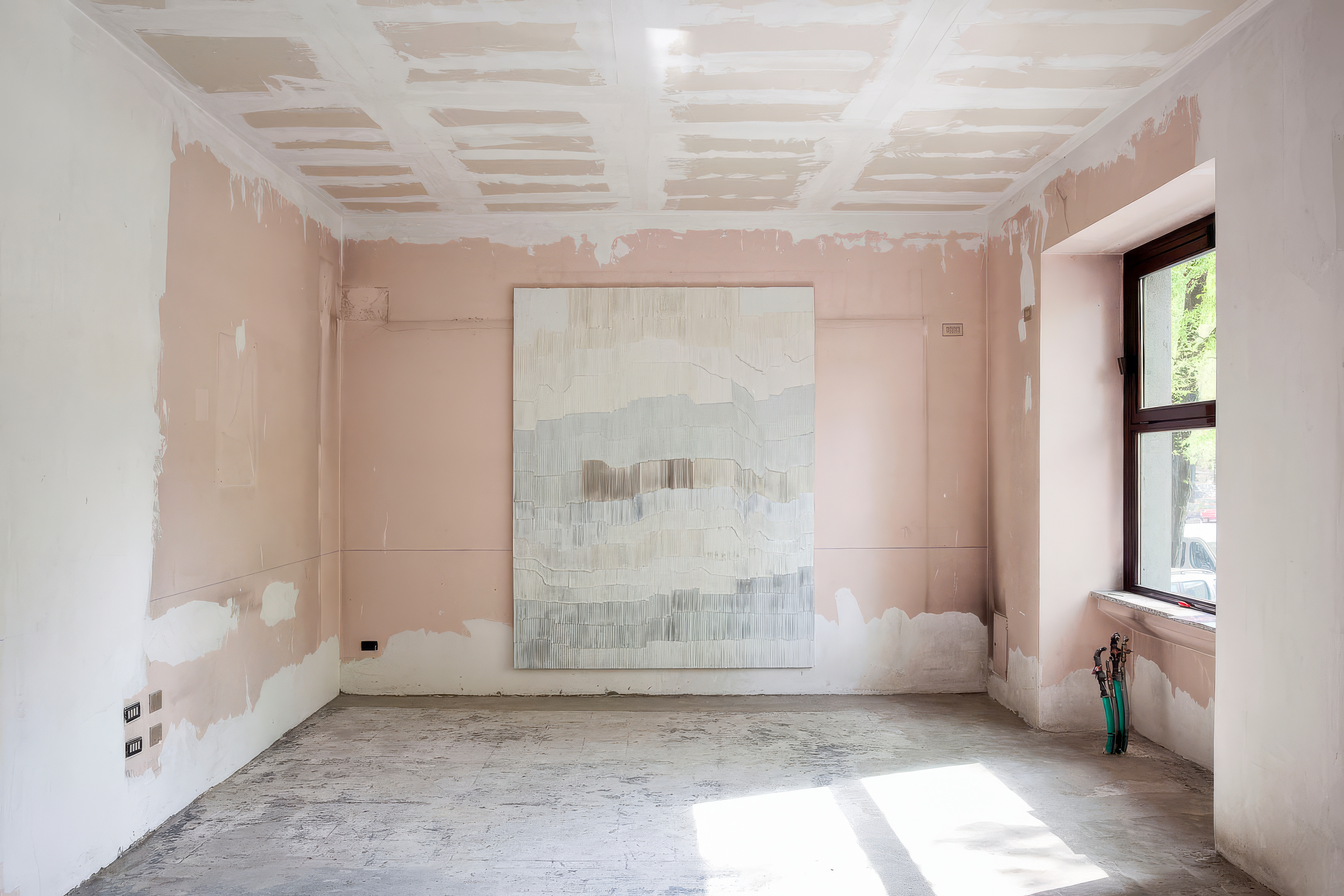
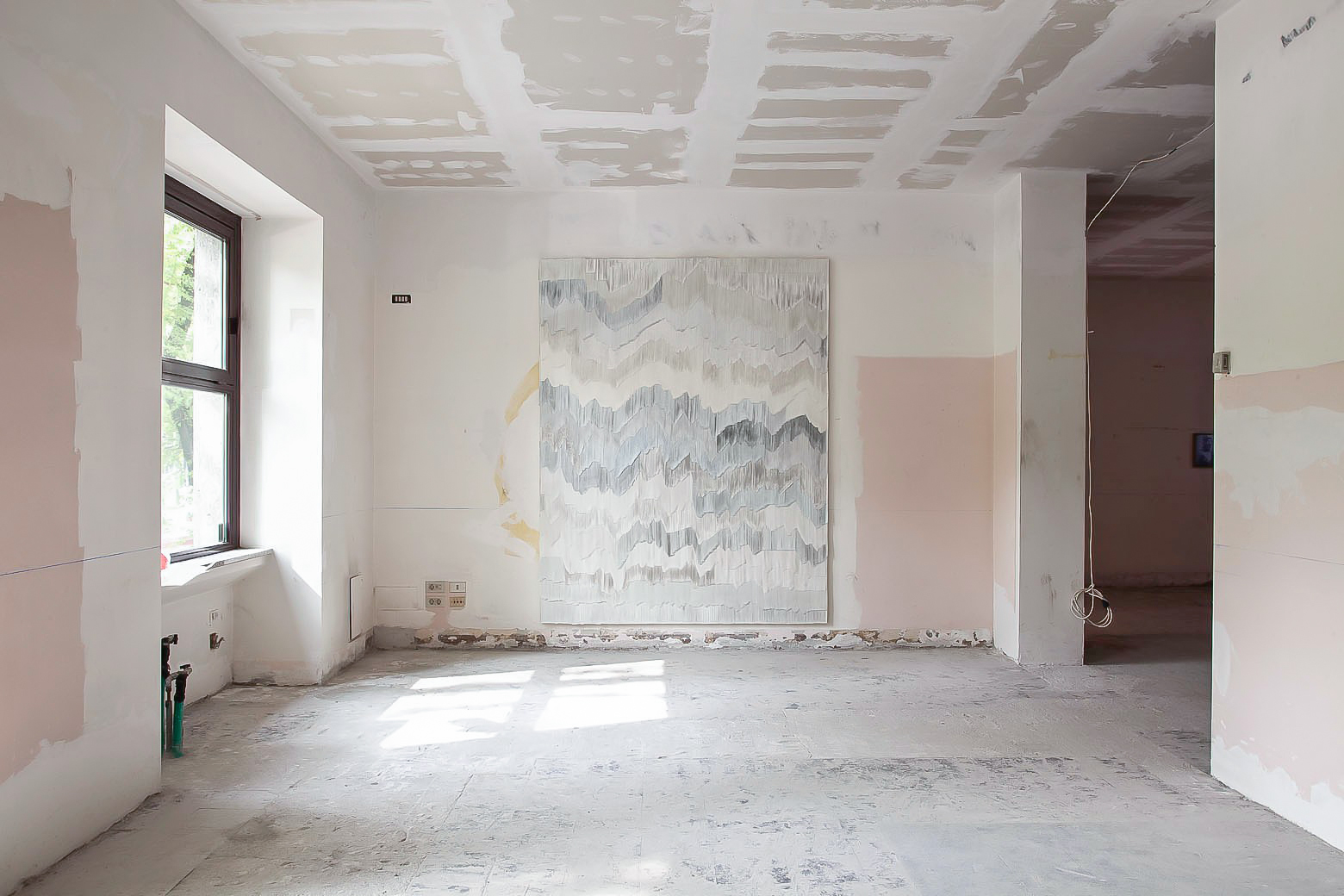
Ots takes these found screens apart as a spectacularly loaded material, slicing them into strips to better understand their power. He also combines ones from different periods, and as particularly volatile material the older ones are more yellowed–the most universal comprehensible sign of ageing next to human wrinkles.
Someone under 35 years old is unlikely to have any memories of family films projected on these ungainly freestanding screens. It happened so rarely as to be of significant effect when it did occur. Our jazzy super-eight camera was a pride and joy of my Dad’s who understood that film was supposed to tell stories with motion. I remember family squabbles over my mother’s inability to take his direction. Instead of performing the action my father was trying to capture she would freeze and just wave at the lens, and get a slightly pained expression as my dad urged her to walk, wave jump, anything other than “stand still and wave”.
—An excerpt of the text by Bill Arning
2013
3 m 19 s, HD video, format 16:9, color stereo sound
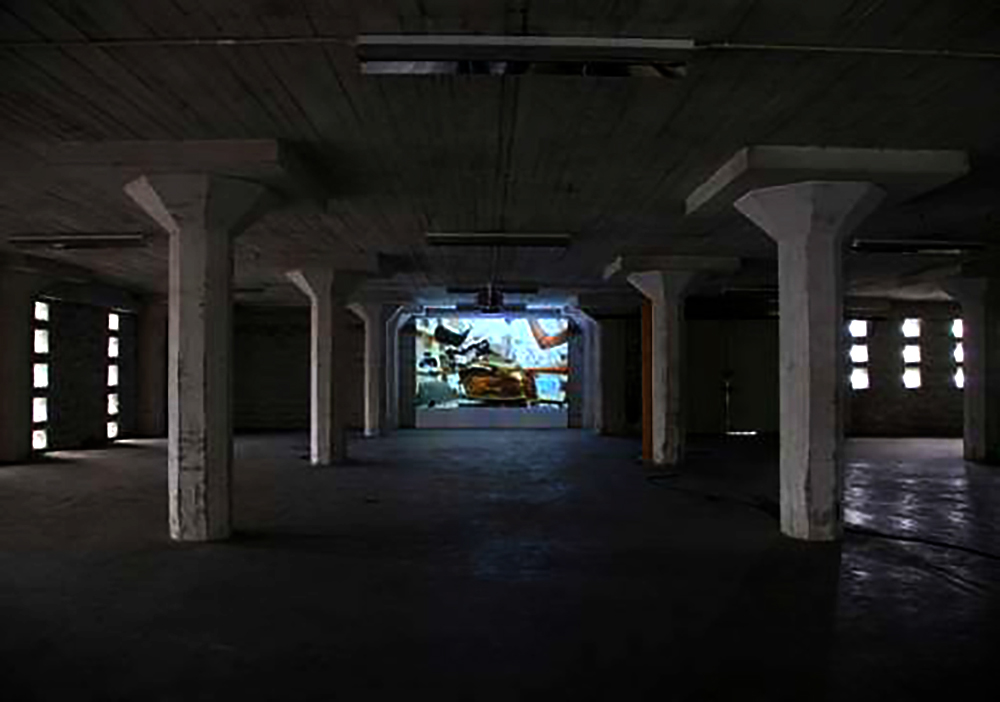
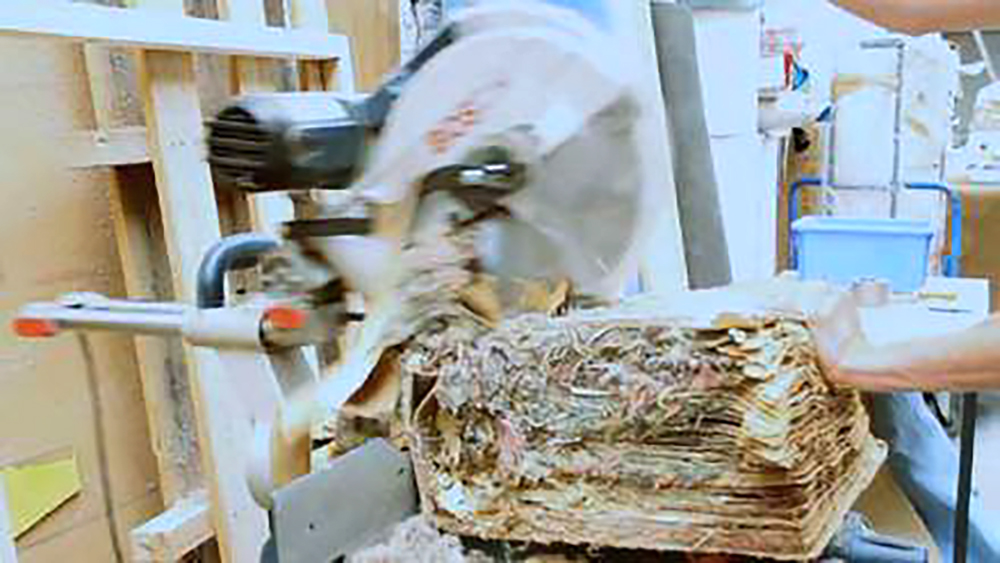
Jurgen Ots attacks a 19th-century fabric sample book with a circular saw. Movement after movement hit after hit, layer after layer, he destroys the old yellowed pages of this document, beats the ghost out of the machine and winds his way through the ancient bulk. He leaves only one half of the book intact, the other half is reduced to scraps and remnants, pieces of paper and pulverized fibres of textile samples that once were arranged carefully in this voluminous book. The movement is violent and radical and doesn’t leave us unmoved, echoing in every bone of our own body.
I mirror this gesture with the Deleuzian “acte de résistance”. Incorporated resistance against defining communication, standards or square systems, the codex. The destruction of this codex, the fragmentation of tissues and signs, the destruction of the regulation. By compulsively picking layers, the system laid in this pages for centuries pulverises, impact after impact, revealing the drawing that matters: leftover debris, the wound and its associated state of dissociation.
The refusal as such ensures that each element is “embodied” and that this body is violated. Nothing escapes the moment: the act of destruction merges with itself and with nothing else. But there lays no end in the dust: one can not speak of hatred or final destruction. The act itself admittedly brings a temporary anxiety and possible regret but the basso continuo that emanates from the pit of this work is one of transformation: the debris doesn’t embody an end but a beginning. The relationship between the perpetrator and the act is a gesture of unity, like the butcher and his stroke, the hunter and his shot and in this case, the artist and his work.
—An excerpt of the text by SBYakoub
2012
Installation, plastic, paint, glue, variable dimensions
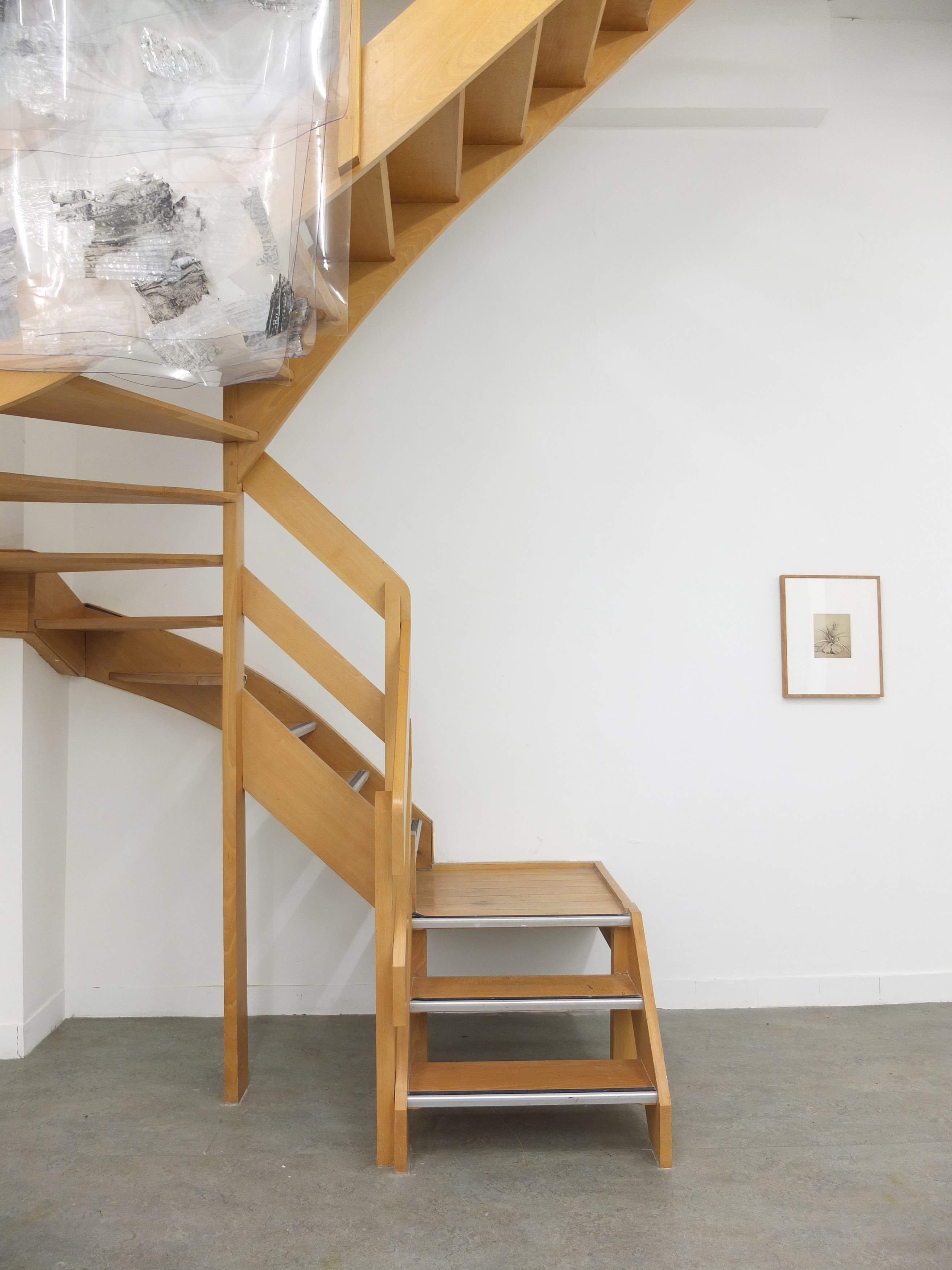
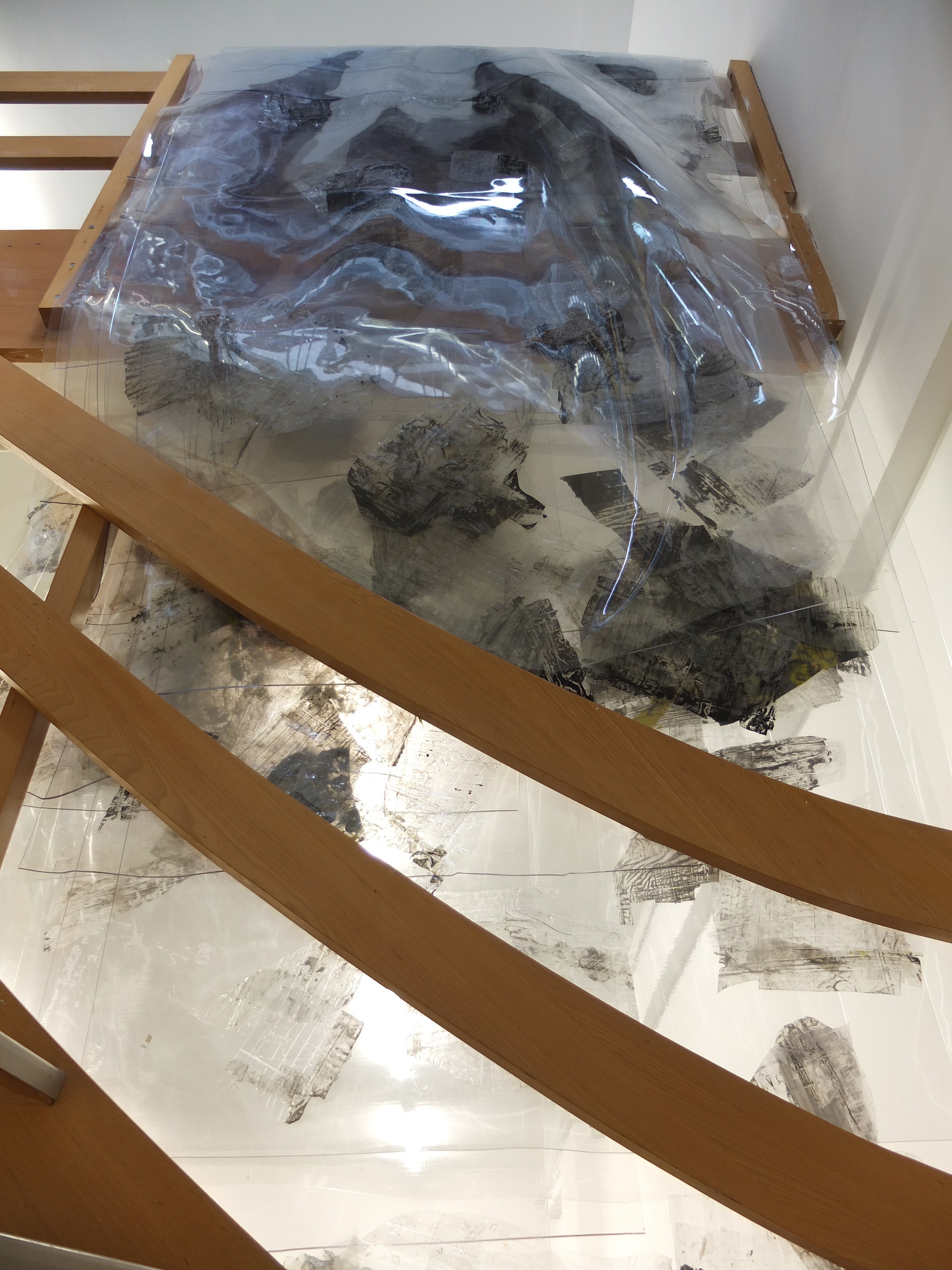
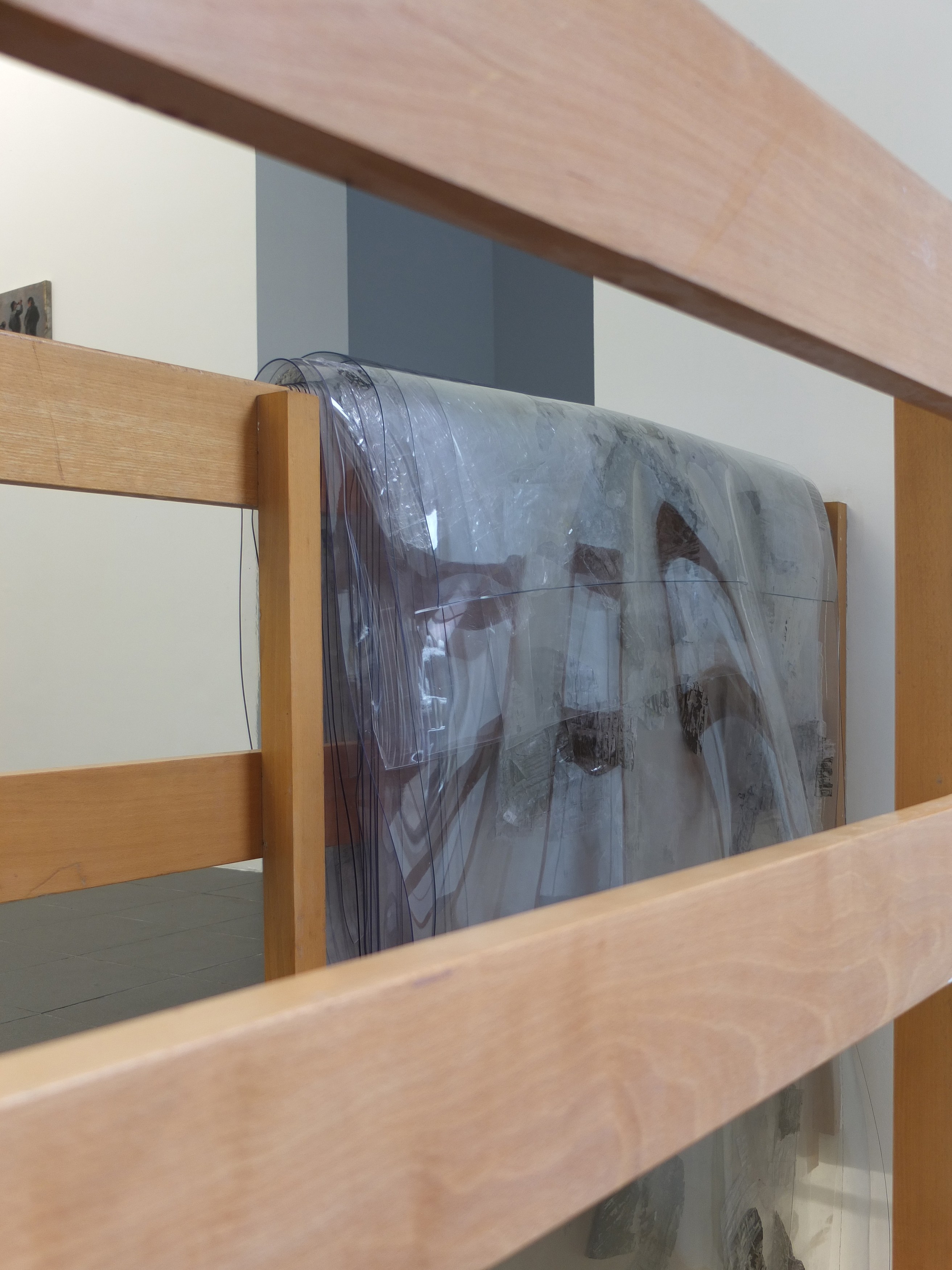
The basic material elements are Xeroxed paper and plastic, ‘circling’ around an already present form, the stairs. The work is processual conceived along the following ‘moments’. The basic, primary motif is a photograph of a row of glass shards sunk in a concrete ridge, of the kind customarily found crowning the walls that encircle a prison (though not only prisons – these elements have become staple features of almost all security architecture).
This photographic detail will be photocopied some thousand times, in a rust-like green colour, on semi-transparent paper. These papers will then be glued together to form random geometric forms of variable sizes. Transparent foil (2 mm thick) will be sliced up in small pieces (2 cm wide, 10cm long) and glued together again; this a process will be repeated some 1000 times.
A dark blue and as of yet undefined second colour (yellow) will be used to coat one of the cluster of foil in paint; this foil will also be (partly) printed upon—the print will run across both the foil and the paper. Three elements (paper, foil and paint) overlap to physically shape the piece. These overlapping layers will then be attached to acrylic glass fields, simultaneously closing off and occupying the space, recreating the memory of the original photographic motif that, though no longer legible as
—An exceprt of the text by Dieter Roelstraete
2010
Installation, architectual paper, DIN A2, black ink, staples, 140 × 210 cm
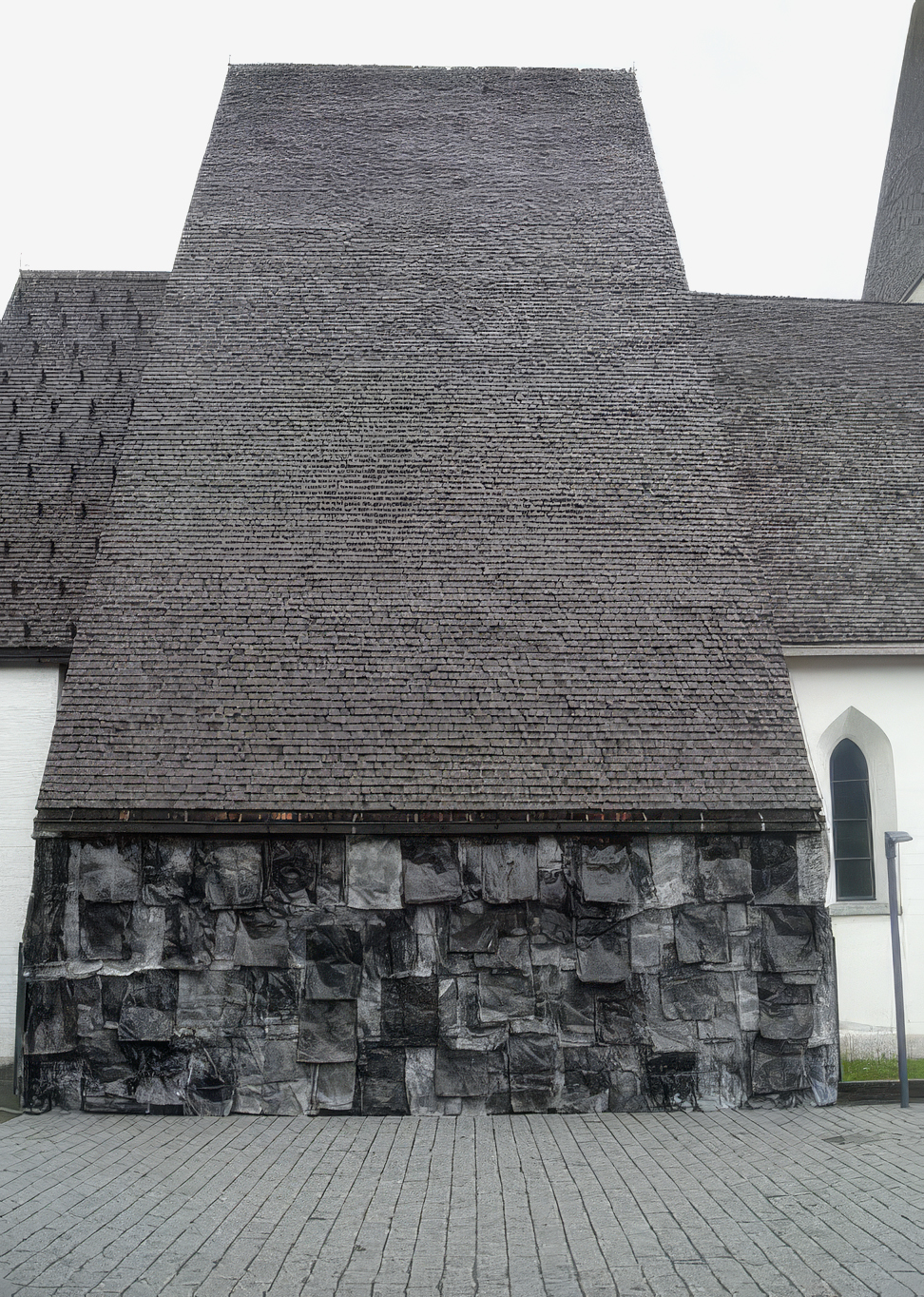
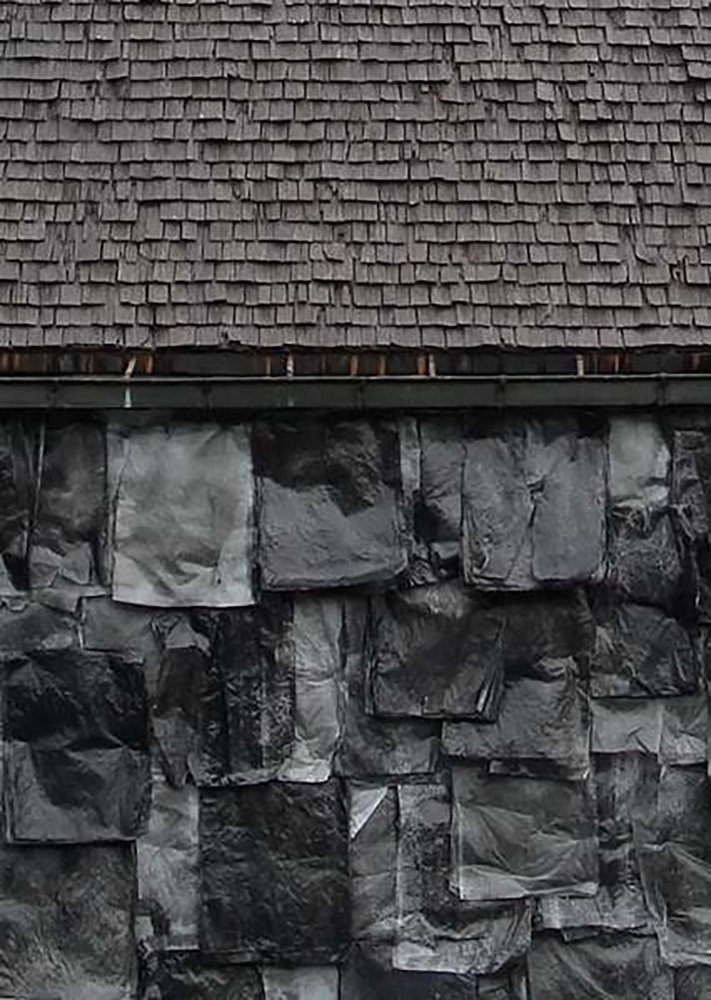
Knowing that the pre-existing construction, its rook and the work can be seen as a single sculpture all together, it may be useful to consider its size: 14 m on 21 m height. Here, transparent paper was crumbled and painted black with mat paint and water, fattened again, attached in layers and then stapled on the wall of the already present architecture.
The photography functions as an underlying layer, paper dealing with its own dimensionality by its crumbling effect. It is a metaphorical vision on a communication failure. Formally there is a continuation of the patterns on the roof, a microscopic enlargement on a life size scale. On the one hand the small repetitive pattern, on the other a fungus-like installation.
2009
Black and white photograph: 19,5 × 21 cm, installation consisting of 5 elements approx.: 275 × 320 × 220 cm
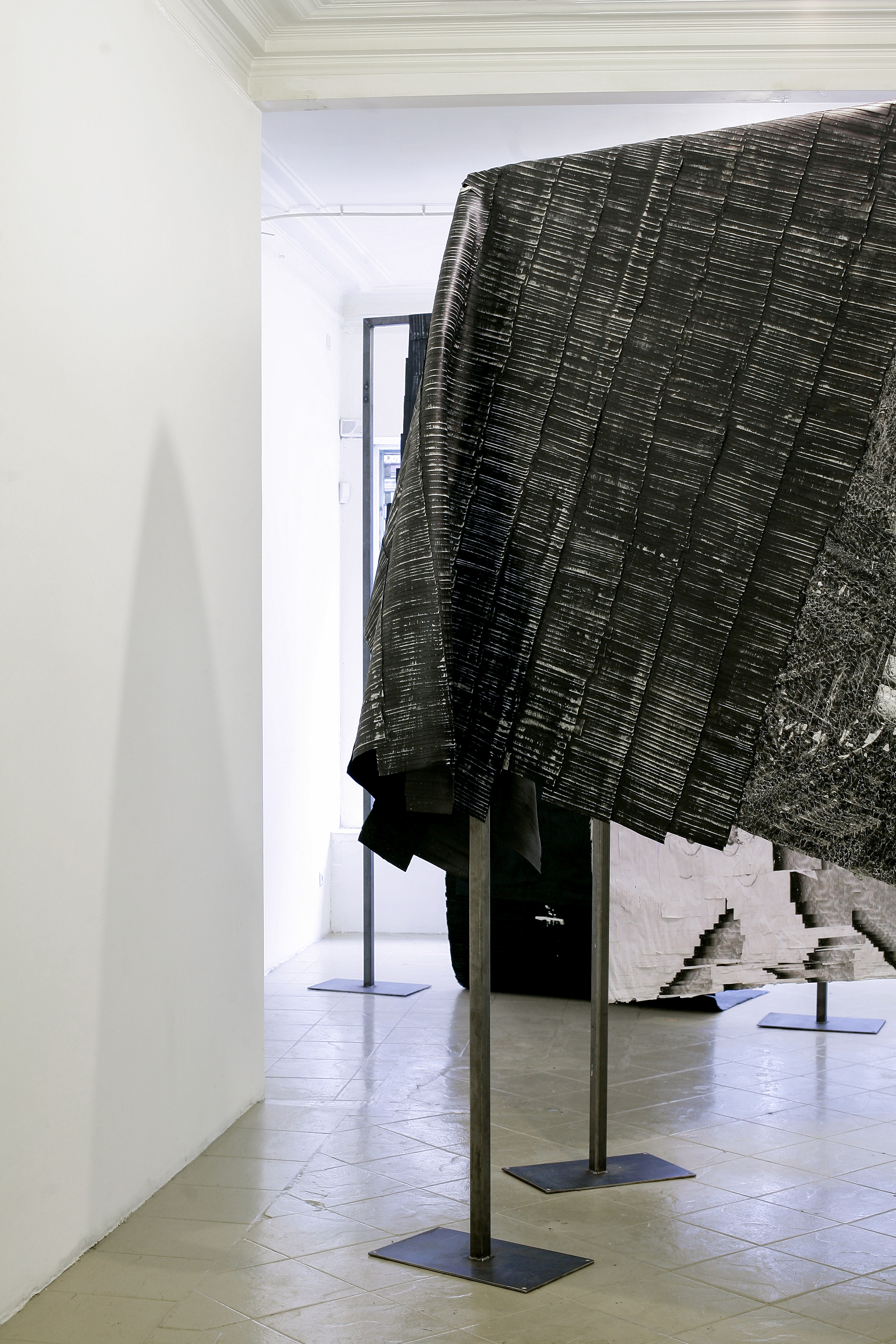
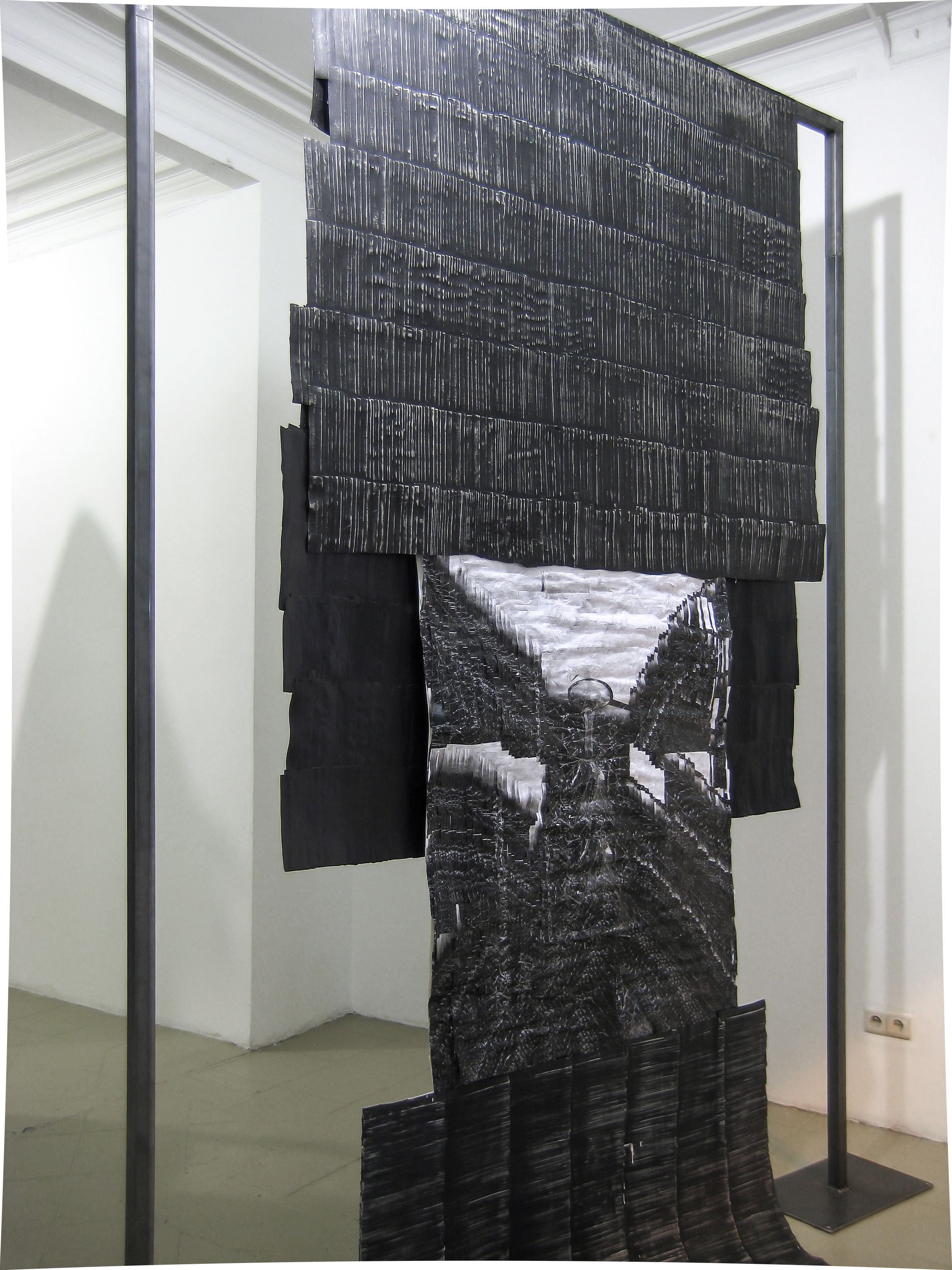
Each of the works appears to be a segment of an indefinite accumulation, and despite this constant addition there is never a build-up of tension. No beginning or end; only a compulsive repetition. As if a single thrust of movement was isolated and then copied numerous times. Take as an example the kind of dream sequence in which one finds onseself in an ever-narrower tunnel; one never experiences the moment one enters the tunnel in question, and in the same way one never experiences the ‘end’ of the tunnel or its narrowing. The scene just stops.
—An exceprt of the text by Michael Van den Abeele
2004
Paper, performance, mini DV transferred to DVD video, 57 sec

A room was chosen and divided by a large net. Found archival papers were packed behind the net creating a trompe-l‘œil: a large scale illusionary wall. The monumentality of the wall created the image of a volume, a space. My actions in front of the massive structure influenced the viewers perception of scale, depth, movement and time. The work is a symbiosis from a previous research in both sketchbooks and archives, eventually translated as a metaphor, the actual essence of looking for.